
A wood dining table does not need to stay hidden to stay in good condition. The practical approach is to match the protection to the risk: use a trivet for heat, coasters and prompt drying for moisture, and a clean protective layer when dishes, crafts or everyday clutter could scratch the finish.
The finish matters as much as the timber. Lacquer, oil, wax, paint and polyurethane can react differently to heat, cleaners and materials left in contact with the surface. Start with the table maker’s care instructions, especially before leaving plastic or rubber against the top for long periods.
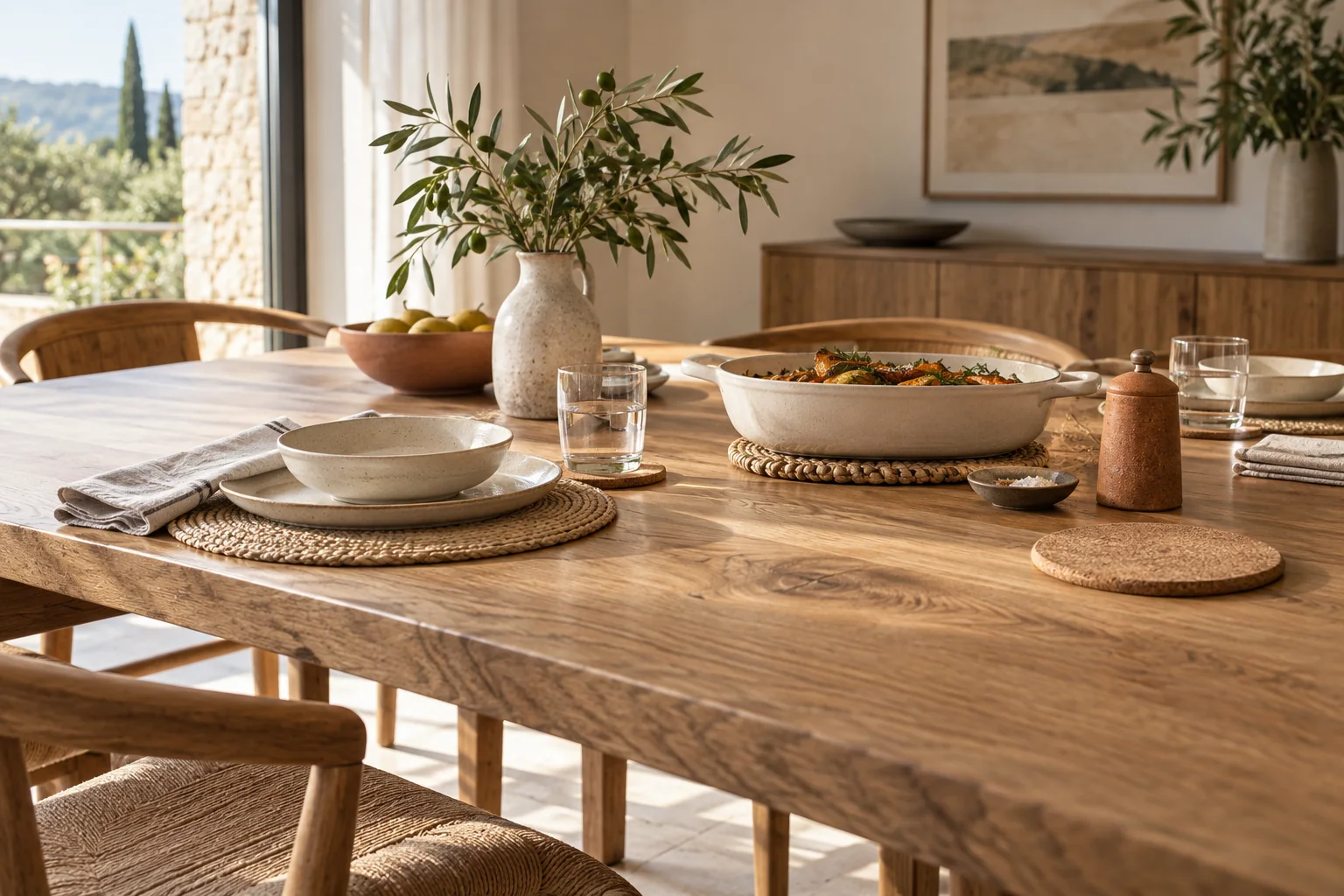
Trivets for heat · coasters for drinks · placemats for place settings · felt beneath decorative objects · a table pad for heavier use
Compare dining table protectorsThe quickest way to protect a wood dining table
| Everyday risk | Best first layer | Useful habit |
|---|---|---|
| Hot cookware and serving dishes | An insulated trivet or hot pad | Set the trivet down before the hot dish reaches the table. |
| Cold drinks and condensation | Coasters with a moisture-resistant surface | Wipe rings and spills promptly, then dry the area. |
| Plates, cutlery and everyday meals | Clean placemats | Lift the mats and remove trapped crumbs after meals. |
| Crafts, homework and entertaining | A tablecloth over a padded protector | Check that both the tabletop and backing are clean and dry. |
| Vases, lamps and decorative objects | Colourfast felt pads | Lift objects instead of sliding them. |
Protect the finish from heat
Put an insulated trivet or hot pad beneath serving dishes, baking dishes, kettles and pans. A decorative runner, thin placemat or tablecloth may soften the setting, but it should not be treated as reliable insulation. Room & Board’s wood-care guidance warns that heat and moisture can damage wood finishes and recommends trivets and coasters.
Think about heat before the food leaves the kitchen. Place the trivet where the dish will sit rather than balancing a hot pan while someone searches for protection. Keep candles in holders that catch warm wax, and avoid putting countertop appliances that generate heat directly on the table for long periods.
Stop water rings and trapped moisture
Use coasters beneath both hot and cold drinks because condensation is often the problem. Blot spills promptly with a soft cloth, then dry the surface rather than leaving it damp beneath a placemat or tablecloth. If liquid reaches beneath a protector, lift the layer and let both surfaces dry fully before replacing it.
Water-resistant does not mean waterproof forever. Seams, scratches and worn areas in a finish can behave differently from an intact surface. Flower vases deserve extra attention: add a coaster or shallow tray beneath the vase and check it regularly instead of waiting for a visible ring.
Prevent scratches without covering the whole table
Most light scratches start with friction. Lift serving pieces and decorations instead of dragging them, put felt beneath hard objects, and shake crumbs from placemats before setting them down again. A grain of grit trapped beneath a mat can move across the finish each time the place setting shifts.
For ordinary meals, a placemat creates a useful buffer beneath plates and cutlery while leaving most of the wood visible. Our guide to the best placemats for round dining tables compares footprints and materials, but the same principle applies to any shape: the mat must fit the place setting without overlapping awkwardly or hanging over the edge.
Choose the right protection layer
Placemats for ordinary meals
Placemats are the least intrusive option. They help with light abrasion and small spills, are easy to lift for cleaning, and allow the table to remain part of the room. They do not protect the centre of the table and should not replace a trivet under hot cookware.
A tablecloth and padded protector for busy use
A quilted protector beneath a tablecloth adds cushioning for family meals, crafts and entertaining. The cloth gives the finished appearance; the pad handles more of the contact. Choose the cloth using our tablecloth size calculator, then match the protector to the tabletop rather than to the cloth’s drop.
A clear fitted mat when you want to see the grain
A clear mat can help with spills and light scratches while keeping the wood visible, but it is not automatically suitable for every finish. Confirm compatibility with the table maker, especially on a new, recently refinished, lacquered, waxed or very smooth tabletop. Clean and dry both surfaces before fitting it, and continue to use a trivet for heat.
Some furniture makers specifically caution against leaving plastic materials on a finish for extended periods. Ethan Allen’s furniture care guide, for example, warns that components in plastic table coverings and mats can migrate into certain finishes. Treat the manufacturer’s guidance for your table as the deciding source.
A rigid custom pad for valuable or unusual tables
A made-to-measure pad gives broader cushioning and can account for extension leaves or an unusual outline. It costs more and requires storage when removed, but it avoids trimming a flexible sheet at home. Compare clear, quilted, reversible and custom options in our guide to the best dining table protectors for wood tables.
Use sunlight and humidity to your advantage
Natural wood changes with its environment. Strong sunlight can create uneven colour, particularly when the same runner or centrepiece stays in one position. Rotate decorative objects periodically and expose extension leaves to similar light when practical. Keep the room reasonably stable rather than placing the table beside a strong heating outlet or in persistently damp air.
Seasonal movement is normal in solid wood. Stickley’s furniture-care guidance highlights relative humidity, extreme temperature changes and direct sunlight as factors in the long-term care of fine wood furniture.
Clean according to the finish
For routine cleaning, start conservatively: use a soft, slightly damp cloth and dry the surface. Do not assume that a general household spray, disinfectant or furniture polish is right for the finish. Products containing alcohol, ammonia, solvents or abrasives can be unsuitable for some coatings, while an oiled table may have a specific maintenance schedule.
Keep the care sheet that came with the table or look up the exact model. If the finish is unknown, test any cleaning method in a hidden area and avoid improvising on a prominent mark. Deep scratches, cloudy heat marks or a softened finish are better assessed by the maker or a furniture-restoration professional.
A five-minute weekly routine
- Lift placemats, runners and decorative objects instead of sliding them.
- Remove crumbs and grit from the tabletop and the underside of each mat.
- Wipe the table according to the finish maker’s instructions and dry it.
- Check felt pads, coasters and trivets for wear or transferred colour.
- Move the centrepiece slightly so one area is not permanently shaded.
Frequently asked questions
What is the best everyday protection for a wood dining table?
For most homes, use coasters, placemats and a proper trivet, then wipe spills promptly. Add a padded protector and tablecloth for crafts, parties or other heavier use. This keeps the table visible during ordinary days without leaving it unprotected when the risk is higher.
Can I put a hot plate on a wood table?
Use an insulated trivet or hot pad beneath a hot plate or serving dish. Do not rely on a thin fabric layer or an unverified heat-resistance claim to protect the finish.
Should I leave placemats on the table all the time?
It is better to lift them regularly so you can remove grit, check for dampness and allow the tabletop to receive more even light and air. Follow the furniture maker’s advice for materials that remain in continuous contact with the finish.
Will a tablecloth prevent scratches?
A tablecloth helps with light contact but provides little cushioning by itself. A clean padded protector beneath it is more appropriate when the table will hold crafts, heavy serving pieces or objects that may be moved around.
Research note: This guide was checked on September 21, 2026 against published furniture-care guidance from Room & Board, Ethan Allen and Stickley. Always follow the instructions supplied with the specific table and finish.
A useful five-minute reset
Set the table without overthinking it.
Get the free two-page checklist, plus one practical Dinner Table note every seven days for the next three weeks.
- Five steps you can use before any meal
- Easy spacing and centerpiece proportions
- Unsubscribe whenever you like